Start here
Choose a finished bib construction with your timing operator. A tag identifies a participant; the complete equipment, software and crossing procedure determine whether that identification becomes a usable timing record.
1. Confirm equipment compatibility
Provide timing-platform, reader and antenna models, software version and course read points. Have the operator confirm tag, EPC format and reader-setting compatibility. Catalogue ISO/IEC 18000-6C / EPC Gen2 information alone does not establish platform compatibility.
Name each country of use. Confirm tag coverage of the local operating band and permitted reader channels and power. GS1 defers relevant operating parameters to local regulations; a broad tag frequency claim does not authorize transmission across that range.
Reference: GS1 EPC Gen2 air-interface standard: protocol and regional operation.
2. Compare finished bib constructions
RT-S120 and RT-S122 share a 97 × 27 mm face and 94 × 24 mm antenna. RT-S120 uses PP over 1 mm foam; RT-S122 uses white PET over >2 mm foam. Compare attachment, printing, comfort and worn-bib capture with identical equipment. Thickness and maximum read distance do not rank race performance.
RT-S121 lists a bib up to 240 × 160 mm with a 94 × 24 mm antenna. Confirm material, tag position, foam thickness, pins, locker cards, assembly and packing in the quotation and sample; kit configuration requires approval.
The three shortlisted baselines use Impinj M830, with 128-bit EPC and no user memory. RT-S132 instead lists NXP UCODE 8, also 128 / 0 bits; its historical M830 URL does not define the chip. Confirm the quoted chip before substitution.
Reference: Impinj M800 series: M830 and M850 memory comparison (PDF).
3. Test the final worn bib
Approve a drawing showing the inlay, fasteners and permitted folds. Wear printed samples on the actual bib with representative clothing and equipment. Include body proximity, sideways approaches and different orientations to the timing antennas.
Repeat with relevant wet conditions, creasing and dense groups at expected speeds. Record construction, placement, group size, antenna direction, settings and repetitions. A dry loose-tag read cannot establish folded, wet-bib performance in a crowded crossing.
4. Agree crossing acceptance criteria
Set the crossing capture window and acceptable missed-crossing threshold before trials. Compare expected bibs with distinct EPCs captured within that window. Keep raw reads and processed crossing records: repeats can inflate totals without adding another participant.
Test tags waiting beside the read zone, adjacent course lanes, turnaround traffic and repeat laps. Agree how software assigns read points, filters unintended reads, consolidates duplicates and preserves valid later crossings. Reconcile misses against an agreed independent reference. Chip identification is not a complete timing system and does not establish finish-time accuracy.
5. Verify mapping and replacements
Use an anonymized representative file with bib identifiers, EPC examples and operator-required fields; names and personal details are unnecessary for sample review. Agree payload length, representation, allocation and duplicate checks. M830 and UCODE 8 have no user memory for additional entrant data.
Agree the tag count and approved EPCs per bib; an EPC must not be active for two participants. Verify printed numbers, barcodes, decoded EPCs and imported records together. For replacements, retire the old active association, activate the replacement and retain history. Test before distribution.
Reference: NXP UCODE 8/8m: chip memory specification (PDF).
6. Plan around the event date
Set dates for samples, field trials, artwork approval, final encoding data, production release, dispatch and required arrival. Allow receipt checks, corrections and spare bib preparation. Agree late-change approval and the data cutoff. Dispatch and arrival are separate milestones; confirm supply timing, fees and freight per order.
- Event date, arrival deadline, destination, sample and order quantities, and spares.
- Timing equipment, software, country, read-zone layout, speed and peak group density.
- Bib drawing, material, artwork, placement, wet exposure and kit contents.
- Anonymized EPC file, replacement process, crossing window and acceptance criteria.
Three catalogue candidates
Compare finished samples; dimensions and memory do not rank capture performance.
| Model / baseline chip | Face / foam construction | Face / antenna | EPC / user memory |
|---|---|---|---|
| RT-S120 · M830 | PP · 1 mm foam | 97 × 27 / 94 × 24 mm | 128 / 0 bits |
| RT-S122 · M830 | White PET · >2 mm foam | 97 × 27 / 94 × 24 mm | 128 / 0 bits |
| RT-S121 · M830 | Bib kit · tag thickness to confirm | Bib up to 240 × 160 / antenna 94 × 24 mm | 128 / 0 bits |
Confirm the selected chip, drawing, kit contents and packing. Approve the complete worn bib, encoded data and timing-system acceptance together.
Explore the catalogue options
Compare two foam constructions and a bib kit.
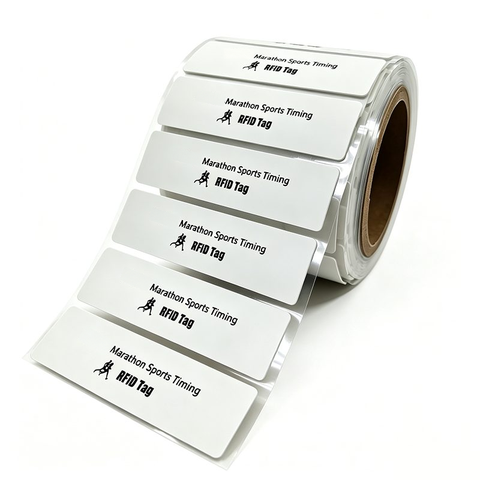
Race Timing UHF RFID label · 97×27 mm · Impinj M830 (RT-S120)
RT-S120: PP face and 1 mm foam.
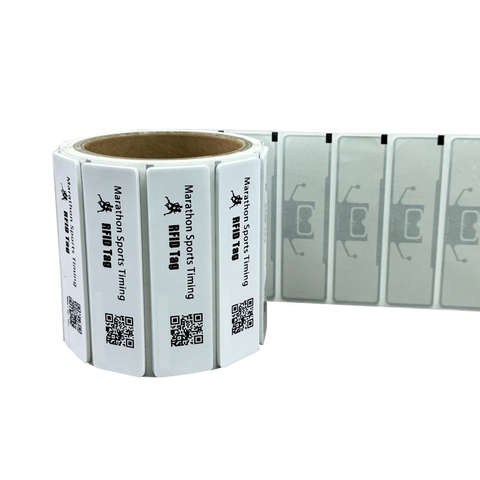
Race Timing Dogbone Inlay UHF RFID tag · 97×27 mm · Impinj M830 (RT-S122)
RT-S122: white PET and >2 mm foam.
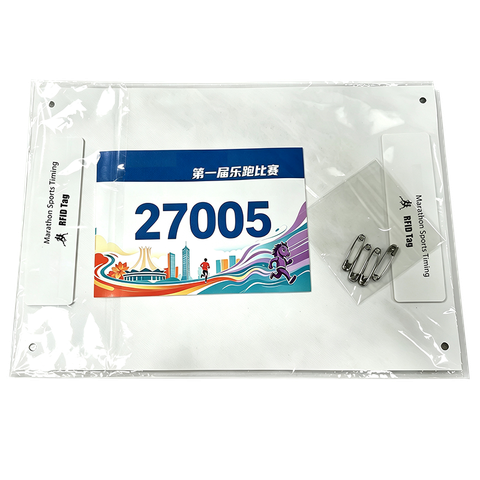
Race Timing UHF RFID bib kit · up to 240×160 mm · Impinj M830 (RT-S121)
RT-S121: bib artwork, placement, accessories and packing.
Technical references
These official sources describe protocol and chip memory, not finished-tag certification. Crossing capture, exception handling and timing accuracy require separate acceptance of the complete event system.