Start here
Decide where the identifier belongs and how long it must stay with the garment. Then compare complete tag constructions, encoded data and sample performance in your actual inventory workflow.
1. Match the format to the garment and attachment process
A removable hang tag is a candidate when the garment already carries a retail ticket and the RFID identifier can leave with that ticket. A sewn-in textile label is a candidate when identification should remain after ticket removal. An adhesive label may suit a price ticket, backing card or package with an appropriate surface.
Mark the proposed tag position on a photo. Include the fabric, folds, seam space, packaging and nearby metal trims or accessories. For a textile label, allow room for sewing outside the inlay. For a hang tag, show holes, fasteners and the printed layout. For an adhesive format, identify the exact surface rather than giving only the garment type.
Reference: Auburn RFID tagging location and validation resources.
2. Separate retail use from wash durability
Sew-in describes an attachment method; it does not establish the number of wash cycles a finished RFID tag can survive. A garment tag intended for retail counting should not be assumed suitable for a rental laundry or industrial uniform process.
If the identifier remains during use, specify wash temperature, detergents or chemicals, drying, pressing and the required cycle count. Ask for evidence covering the proposed construction and agree on sample checks through that process. Include attachment condition and readability after treatment in the acceptance criteria.
- State explicitly whether the tag will be removed before washing.
- Provide the complete care or laundry process, including drying and pressing.
- Use finished garments in the trial; a loose-label demonstration does not test sewing or wear.
3. Approve the printed identity and encoded identity together
Send artwork, barcode data, the EPC scheme and a representative encoding file. Agree who allocates serial numbers and prevents duplicates between suppliers, factories and repeat orders. Verify that the printed product identity and decoded RFID identity refer to the same item before production approval.
Choose memory for the encoded payload. RT-T102 has a 96-bit EPC; RT-G101 and RT-L112 have 128-bit EPC memory. None of those three catalogue models has user memory. GS1 defines restrictions for EPC coding schemes: for example, SGTIN-96 requires numeric serials without leading zeros and within its permitted range. Confirm the scheme, serial format and capacity with your system owner before a chip substitution.
Reference: GS1 guidance on EPC serialization and memory capacity.
4. Check the exact retailer requirement
Provide the current retailer playbook, required inlay Spec, tag location and data requirements. ARC approval is tied to an inlay and the relevant Spec. Match the proposed inlay to the current approved list and request model-specific documentation before purchase; a chip name or a retail category title is insufficient.
Keep mandate documentation with the approved artwork, encoded sample and construction details. If a supplier changes the inlay, chip, position or packaging, ask your program owner what needs to be reviewed again.
Reference: Auburn ARC current approved inlay lists.
5. Run a trial that represents receiving and inventory work
Test candidates on the same garments and at the same proposed tag position. Include hanging items, folded stacks and the cartons used for receiving. Add difficult fabrics, trims and orientations to the trial. Record the reader model, antenna setup, deployment country and band, settings, intended reading time and missed items.
A successful read from one loose tag does not establish performance for a packed carton or a store rack. Agree the capture target and handling conditions with your integrator, then compare results under those conditions. If washing is required, repeat the checks after the agreed process. Approve the construction, placement and data together before a volume order.
- Check the target items are captured within the real workflow time window.
- Check how the system handles nearby items outside the intended inventory group.
- Decode the EPC and compare it with the approved data and printed identity.
- Record attachment damage, missed reads and any changes made between trials.
Three catalogue candidates to compare
These models illustrate different attachment formats. Their listed dimensions and memory help prepare a shortlist; they do not establish wash durability, retailer approval or a guaranteed read distance.
| Model / format | Label / antenna size | EPC / user memory | Check on your item |
|---|---|---|---|
| RT-T102 · nylon textile | 60 × 30 / 42 × 16 mm | 96 / 0 bits | Sewing space, face feel and any wash process |
| RT-G101 · apparel hang tag | 83 × 25 / 70 × 14 mm | 128 / 0 bits | Ticket layout, fastener and handling |
| RT-L112 · retail adhesive label | 45 × 19 / 42 × 16 mm | 128 / 0 bits | Ticket or package surface and placement |
Catalogue facts are starting points. Confirm the final inlay, face material, attachment, encoded data and any required evidence in the quotation and sample approval.
Explore the catalogue options
Use these product specifications to prepare your shortlist. Confirm the final construction in your quotation and sample approval.
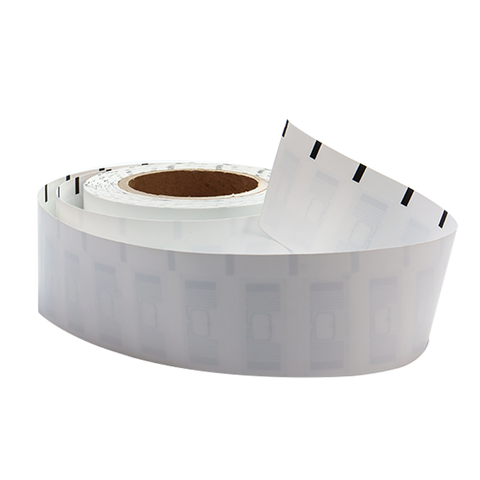
Nylon UHF RFID textile tag · 60×30 mm · NXP UCODE 9 (RT-T102)
60 × 30 mm nylon textile format with UCODE 9 and a 42 × 16 mm antenna for a sew-in sample trial.
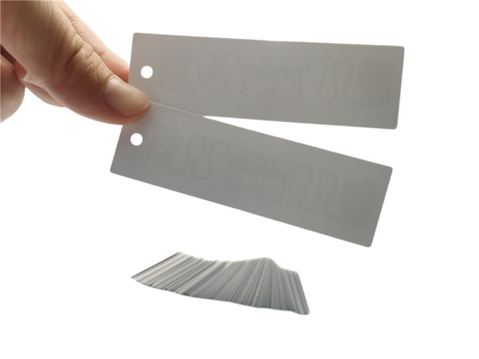
Apparel UHF RFID hang tag · 83×25 mm · Impinj M730 (RT-G101)
83 × 25 mm M730 apparel hang tag when a removable printed ticket fits the tagging workflow.
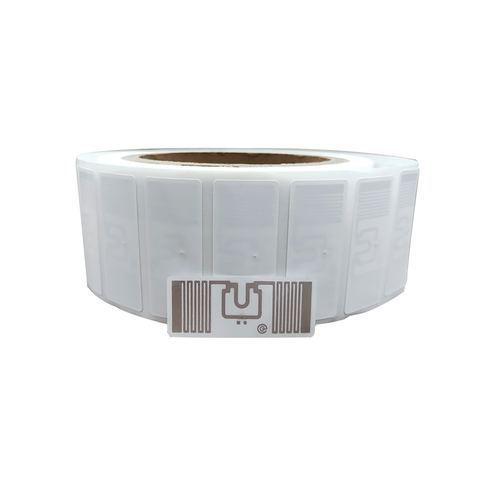
Retail UHF RFID label · 45×19 mm · Impinj M830 (RT-L112)
45 × 19 mm M830 retail label to evaluate on the intended ticket, backing card or package surface.
Technical references
This guide combines the published Rivotag catalogue specifications with the primary technical references below. Product selection still depends on your item and reading setup.