Start here
For dry corrugated cartons, an adhesive UHF label is a starting point. For packed liquids, foil or metal, the contents and tag position need a separate trial. Define whether you need an item, carton, pallet load or reusable pallet identifier before choosing the label and encoding.
1. Decide what the identifier represents
A carton can be a trade item, a logistics unit, or both in different business processes. In GS1 systems, SGTIN identifies a serialized trade item; SSCC identifies a logistics unit such as a case or pallet load. A reusable pallet is a separate asset, for which GRAI may apply. Agree the identification level with the receiving partner and warehouse system owner before sending an encoding file.
A pallet-load identifier does not contain a verified list of every carton or item inside it. Record those relationships in your software when the load is built, and define what happens when cartons are removed or the load is rebuilt. Keep a reusable pallet’s asset identity separate from the identity assigned to its current shipment.
- State whether the read point must capture one load ID, each carton ID or each item ID.
- Supply the agreed EPC coding scheme and a sample value; a barcode string is not a complete binary encoding specification.
- Name the party that allocates identifiers and checks uniqueness across sites and repeat orders.
Reference: GS1 EPC Tag Data Standard: identification schemes and binary encodings.
2. Review the filled carton, not only the cardboard
Dry cardboard is only the outer surface. Bottles, cans, foil pouches and metal parts behind that surface can change RFID behavior. Metal can reflect RF signals and liquids can absorb them. Photograph the opened carton as well as the outside, and mark the candidate tag positions. Include the pallet material, stretch wrap and any metal stillages used along the route.
Compare positions on the real packed unit. Keep the antenna clear of proposed folds, seams and locations where the label may be damaged. When the label is applied directly to metal, review a construction intended for metal mounting. A general logistics label should not be treated as an on-metal or liquid-resistant tag without evidence for that finished construction.
Reference: Zebra RFID Programming Guide: package contents, interference and media setup.
3. Match the print layout and encoding to the finished media
Reserve space for the shipping barcode, readable ID and any address or handling information. Label size is the finished face; antenna size is the inlay inside it. The three candidates below have different proportions, so approve a scaled print proof rather than choosing by the label’s area alone. Check adhesion on your board finish after the moisture, temperature and handling expected in transit.
If you print and encode in-house, provide the exact RFID printer model and option, label pitch, liner width, roll core, winding and inlay position. Run the printer’s media and RFID calibration with the proposed roll. Agree the EPC scheme, payload and readback check with the system owner: RT-L151 lists 96-bit EPC memory, while RT-L143 and RT-L144 list 128 bits. All three listed configurations have no user memory.
Reference: Zebra ZD421/ZD621 RFID calibration example.
4. Specify the country and the read point together
List every country where the shipment will be read, including the destination warehouse. Have the integrator confirm the permitted reader band and operating settings at each location, then request the tag’s suitability for those bands. A broad UHF frequency description is not permission for a reader to transmit anywhere in that range.
Describe the actual movement: cartons on a conveyor, a pallet carried by a forklift, or a stationary handheld check. Record the reader and antenna models, antenna positions, approach direction, load orientation, passage speed and time available for capture. State whether the same label position must work at multiple receiving sites. Those details turn a request for “warehouse RFID labels” into a sample brief that can be evaluated.
Reference: GS1 RFID standards and country spectrum resources.
5. Approve samples against a shipment acceptance plan
Build representative shipments with the proposed labels, normal carton fill, stacking pattern and wrap. Include the densest loads and the liquid or metal contents that will occur in production. Repeat the intended handling and portal passage with different load orientations. Keep a manifest of expected identifiers so missed cartons cannot disappear inside a total read count.
Agree the capture threshold, number of trial passes, handling conditions and exceptions process before the comparison. Count the required distinct identifiers captured in the permitted time window, and record identifiers captured from adjacent loads. A portal that reads extra freight needs system-level filtering or a revised read zone. If the task is to identify every carton, reading only the pallet label does not satisfy that test.
- Compare the decoded EPC, printed ID and barcode with the approved data file.
- Record misses and nearby unintended reads for each direction and packing pattern.
- Check labels remain attached and readable after the agreed handling and environmental exposure.
- Save the approved label construction, placement, reader settings and test results before ordering volume stock.
Three label formats for a carton or pallet-load trial
These catalogue examples offer different print areas and inlays. They are candidates for controlled sampling, with no performance ranking implied by the face or antenna dimensions.
| Model / chip | Label / antenna size | EPC / user memory | Shortlist when |
|---|---|---|---|
| RT-L151 · NXP UCODE 9 | 100 × 50 / 95 × 10 mm | 96 / 0 bits | The shipping layout fits a rectangular face |
| RT-L143 · Impinj M730 | 100 × 100 / 80 × 20 mm | 128 / 0 bits | The print proof needs a larger square face |
| RT-L144 · NXP UCODE 8 | 101 × 38 / 94 × 24 mm | 128 / 0 bits | The available application area is a narrow panel |
Dimensions, chips and memory are taken from the listed product specifications. Confirm the exact face, adhesive, inlay, deployment bands and encoded payload in the quotation. These examples do not establish performance on liquid-filled or metal-containing loads.
Explore the catalogue options
Use these product specifications to prepare your shortlist. Confirm the final construction in your quotation and sample approval.
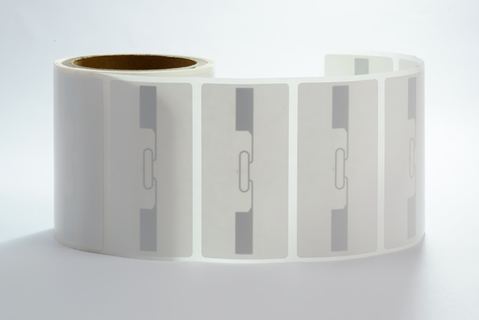
UHF RFID label · 100×50 mm · NXP UCODE 9 (RT-L151)
RT-L151: a 100 × 50 mm self-adhesive label with a 95 × 10 mm antenna and UCODE 9 for a rectangular shipping-label proof.
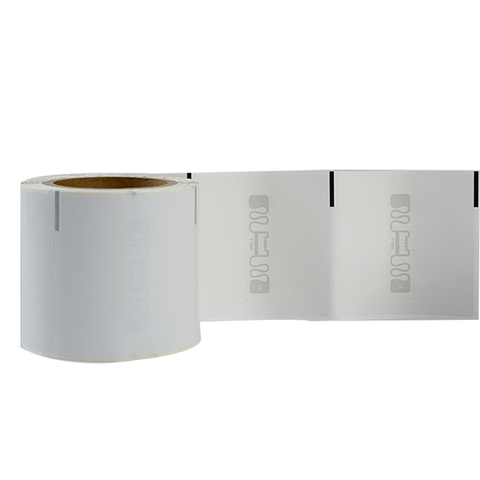
Logistics UHF RFID label · 100×100 mm · Impinj M730 (RT-L143)
RT-L143: a 100 × 100 mm logistics face with an 80 × 20 mm antenna and M730 when shipment information needs more print space.
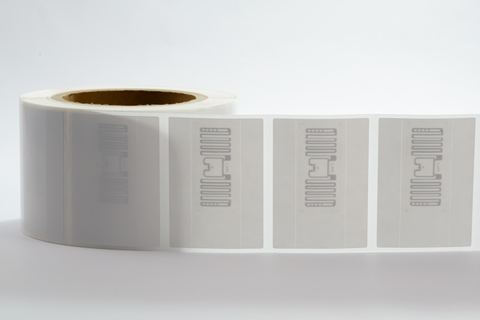
Logistics UHF RFID tag · 101×38 mm · NXP UCODE 8 (RT-L144)
RT-L144: a 101 × 38 mm logistics format with a 94 × 24 mm antenna and UCODE 8 to compare on a narrow carton panel.
Technical references
This guide combines the published Rivotag catalogue specifications with the primary technical references below. Product selection still depends on your item and reading setup.