Start here
Choose the attachment around the piece and its display, then test the complete tray. A compact jewelry format does not establish direct-on-metal performance, counting speed or reusable service life.
1. Compare the attached footprint and print area
Start with the ring, chain, watch or other piece: where can a tag hang without obscuring the display or interfering with handling? RT-E102 uses a narrow tail that folds over to hang on the item. RT-S137 folds from a 43 × 28.5 mm print face to 14 × 28.5 mm. RT-S127 is a 30 × 15 mm PVC format with a hole for cord attachment.
Request a drawing showing the antenna, chip, fastening and permitted folds. An outer dimension does not locate safe fold or adhesive zones. Approve a scaled artwork proof, then check the printed, attached sample for legible prices and barcodes, presentation, retention and removal. Define any tamper-evident requirement separately.
2. Treat metal proximity as a placement question
Metal affects UHF behavior; dedicated on-metal tags use constructions designed for that surface. A jewelry application name does not establish that these three formats can be stuck directly to metal. Include the piece, clasp, watch hardware, tray lining and display fittings in the placement trial.
Compare the proposed hanging positions and orientations with the actual reader. If direct metal mounting is required, request a suitable on-metal construction and test that installation separately. Do not infer a working distance from the chip name or antenna size.
Reference: GS1: RFID performance around metal and water.
3. Test mixed trays against an expected item list
Prepare an expected list of individual identifiers for representative mixed trays, including dense chains, rings and the difficult orientations in your stock. Use the normal handheld or fixed reader, antenna positions and approved regional settings. Set the required capture time and acceptance criteria before comparing samples.
Repeat the normal inventory movement with populated neighboring trays. Count required distinct identifiers, missed items and unintended reads; a high total read count can include repeated or nearby tags. Keep reader settings fixed while comparing attachment positions.
- Record the tray layout, item positions, reader settings and trial repetitions.
- Compare printed ID, barcode, decoded EPC and the expected inventory record.
- Repeat after the agreed handling, cleaning and removal process.
4. Define item identity and the reuse procedure
Agree a unique item identifier, the EPC scheme and a sample encoded record with the inventory-system owner. GS1 workflows use the applicable Tag Data Standard encoding; a printed SKU alone is not a complete EPC instruction. RT-E102 lists 96-bit EPC memory; RT-S137 and RT-S127 list 128 bits. All three listed configurations have no user memory.
For reusable RT-S127 samples, agree whether the EPC changes for each piece or identifies a reusable tag linked in software. Close the old association before assigning the next item, keep the item history, verify the new mapping and replace any obsolete printed information. Do not reassign a serialized item identity to a different piece.
NXP specifies 100,000 write cycles for UCODE 8 memory. That chip figure is not a rating for finished-tag reuse: define attachment, cleaning and handling cycles, inspect samples and repeat the reading test. Confirm locks and programming requirements before approving a reusable configuration.
Reference: GS1 EPC Tag Data Standard: identifiers and binary encoding.
5. Send a sample brief that distinguishes the options
Use the comparison below to request finished samples in the proposed attachment. Include:
- Piece and tray photos, materials, tag space, fastening and removal requirements.
- Artwork, barcode, EPC scheme, example record and any tag-to-item mapping.
- Reader and antenna models, country, tray density, capture time and acceptance criteria.
- Handling or cleaning process, reuse cycles, sample and order quantities, delivery country and required date.
Three jewelry formats to shortlist
These catalogue constructions address different attachment and display choices. Their dimensions do not rank read performance.
| Model / chip | Construction / material | Face / antenna | EPC / user memory |
|---|---|---|---|
| RT-E102 · UCODE 9 | Tailed label · PP synthetic paper | 79 × 10 / 37 × 8 mm | 96 / 0 bits |
| RT-S137 · UCODE 8 | Folded tag · matt white PP | 43 × 28.5 / 25 × 12 mm; folded face 14 × 28.5 mm | 128 / 0 bits |
| RT-S127 · UCODE 8 | Cord attachment · white PVC | 30 × 15 / 25 × 12 mm | 128 / 0 bits |
Confirm the final chip, drawing, material, printing and attachment in the quotation. A reusable or eco catalogue label does not establish tested service cycles or a recycling certification.
Explore the catalogue options
Use these product specifications to prepare your shortlist. Confirm the final construction in your quotation and sample approval.
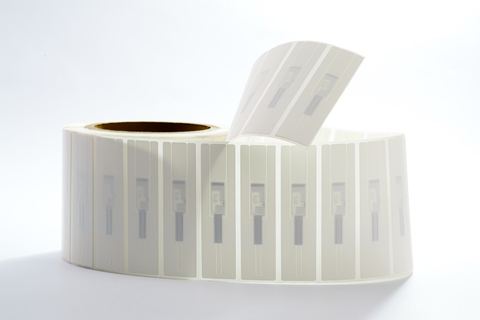
Jewelry UHF eco RFID label · 79×10 mm · NXP UCODE 9 (RT-E102)
RT-E102: evaluate the narrow tail against the piece and display.
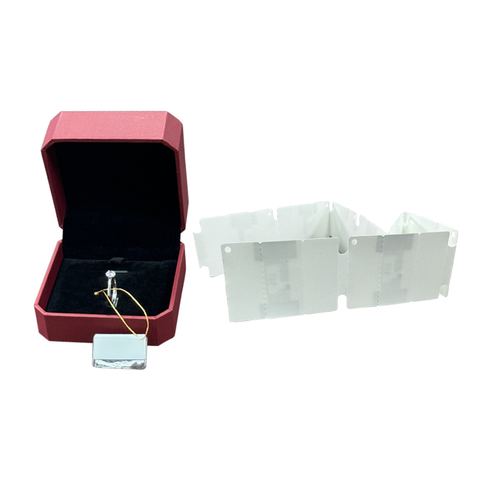
Jewelry Foldable UHF RFID tag · 43×28.5 mm · NXP UCODE 8 (RT-S137)
RT-S137: compare the print proof with the folded presentation.
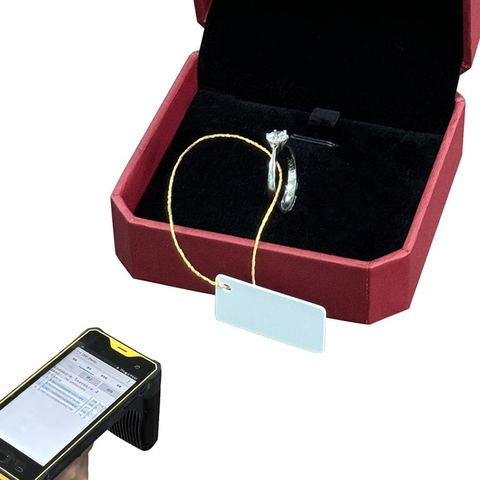
Jewelry UHF RFID tag · 30×15 mm · NXP UCODE 8 (RT-S127)
RT-S127: trial cord attachment, handling and tag reassignment.
Technical references
This guide combines the published Rivotag catalogue specifications with the primary technical references below. Product selection still depends on your item and reading setup.